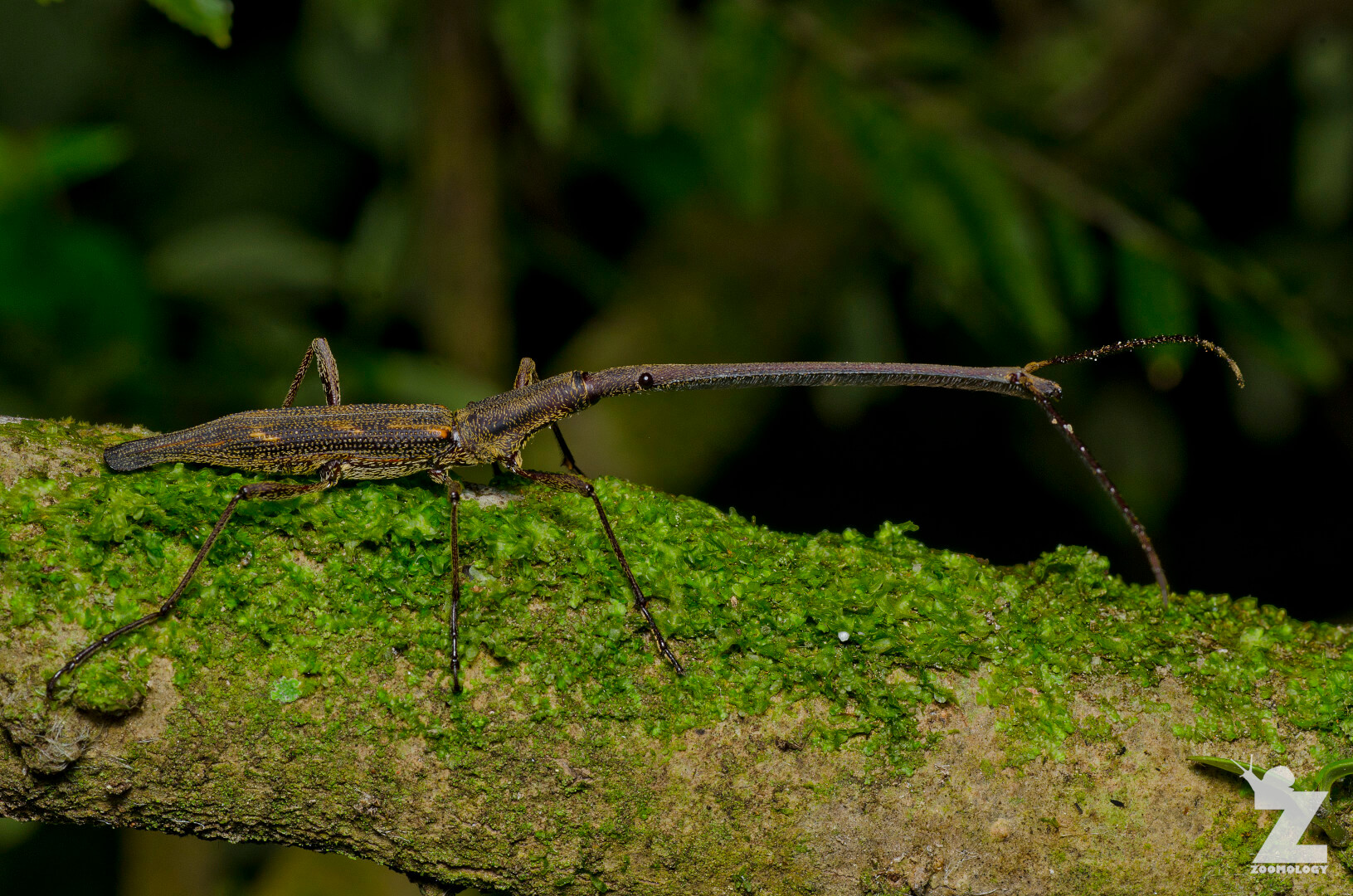
The New Zealand giraffe weevil (Lasiorhynchus barbicornis) is endemic to our country, and is in fact our longest beetle. It is also the longest beetle in the world of its family (Brentidae), mostly owing to its extremely elongated rostrum (the extension of its head as seen below) displayed by adult males. Males measure up to 90 mm, and females 50 mm.
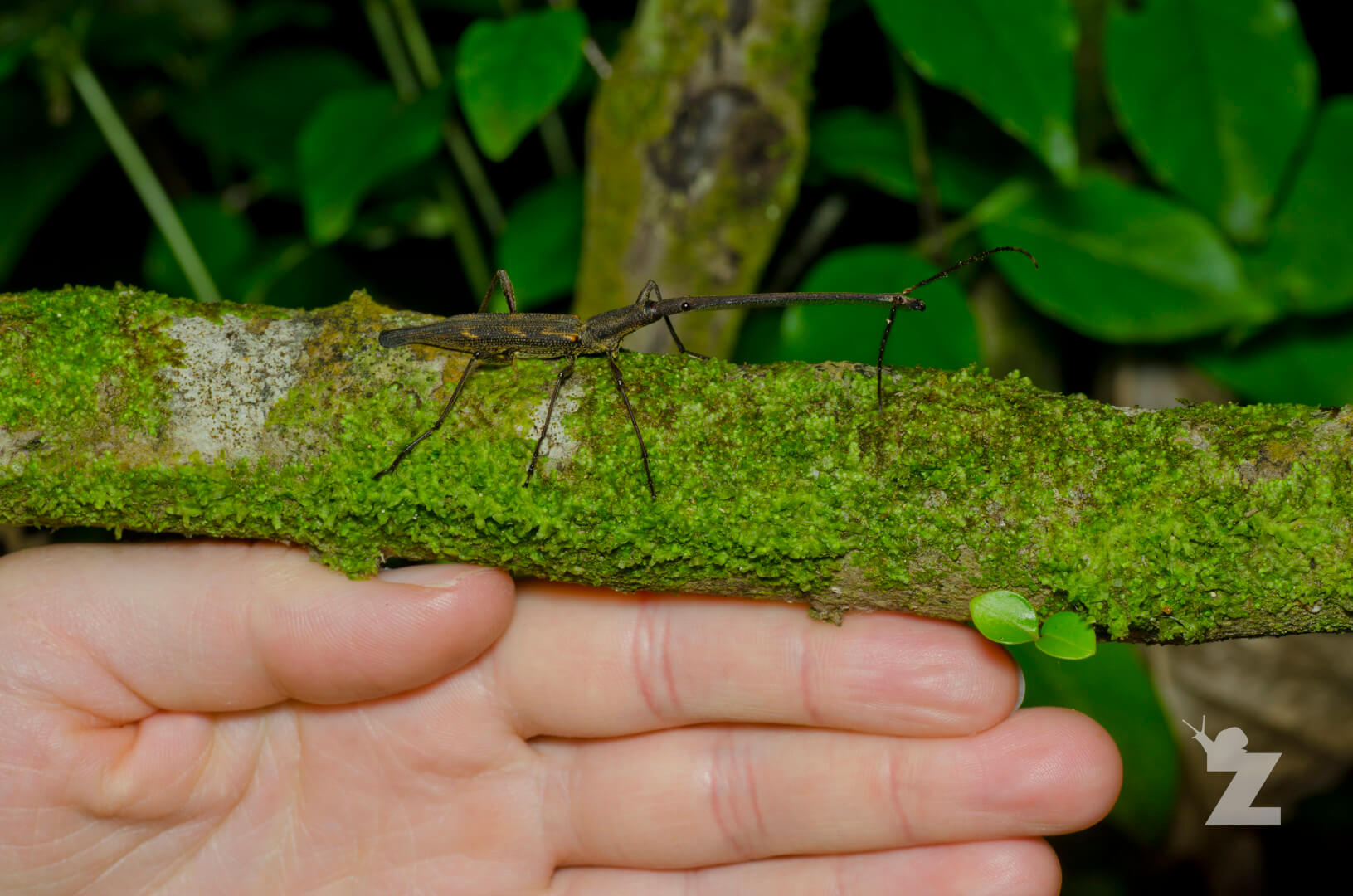
Click to zoom in
Giraffe weevils are part of the order that contains all beetles, Coleoptera. They are in the family, Brentidae, which are also known as ‘primitive weevils.’ Like true weevils, primitive weevils have long snouts for boring into plants. Of this family, there are approximately 2500 species known worldwide, with about six in New Zealand.
Lasiorhynchus means “densely hairy rostrum”, and barbicornis means “bearded horn”. This most likely refers to the dense backward-directed beard underneath the male’s rostrum, or possibly to its hairy antennae. Until we took this close-up shot of the male’s head, we hadn’t even noticed his “beard”. But, as soon as we looked down at the image on the camera screen, we were both amazed (and amused!) by his furry snout.
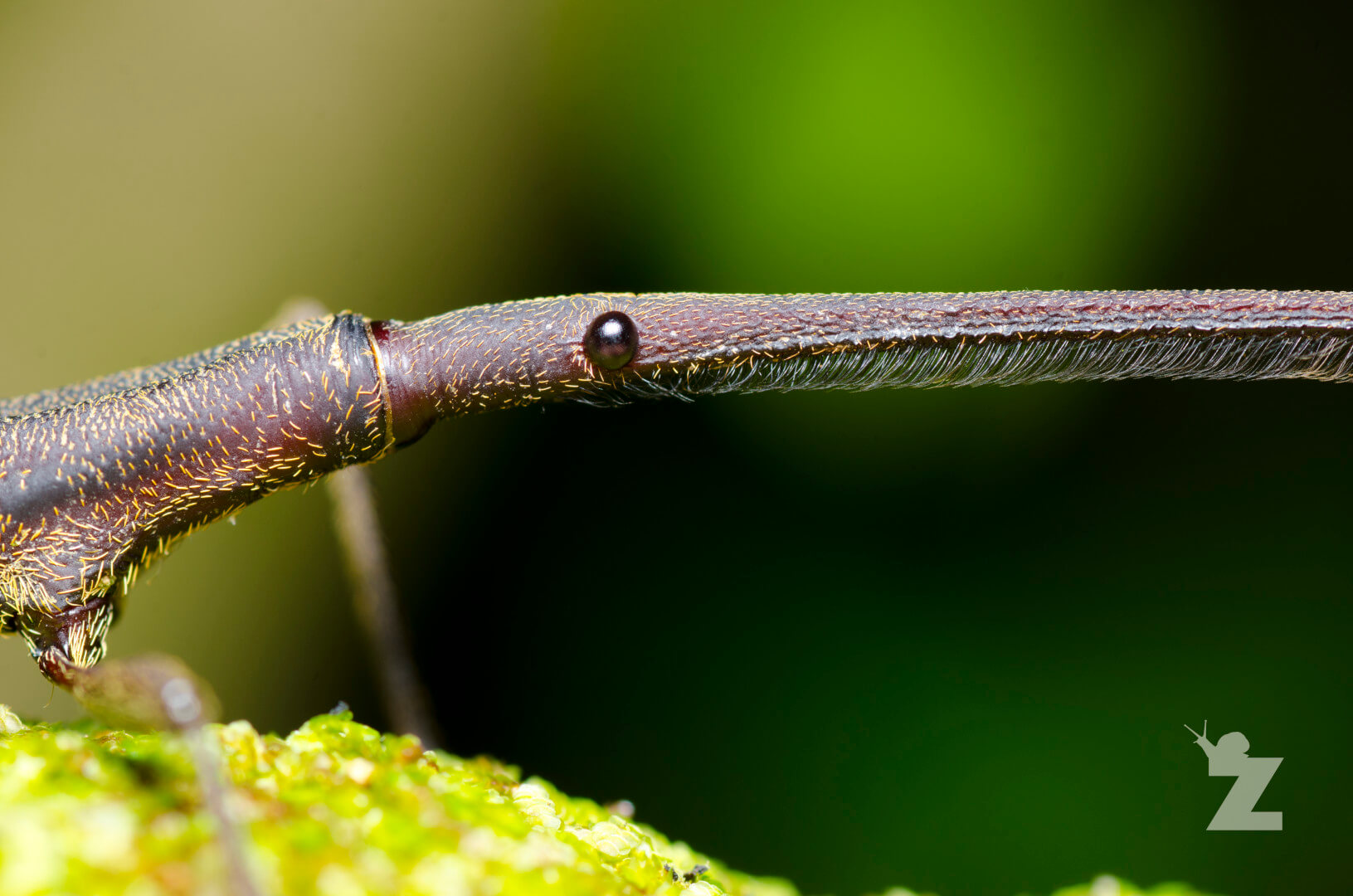
Click to zoom in
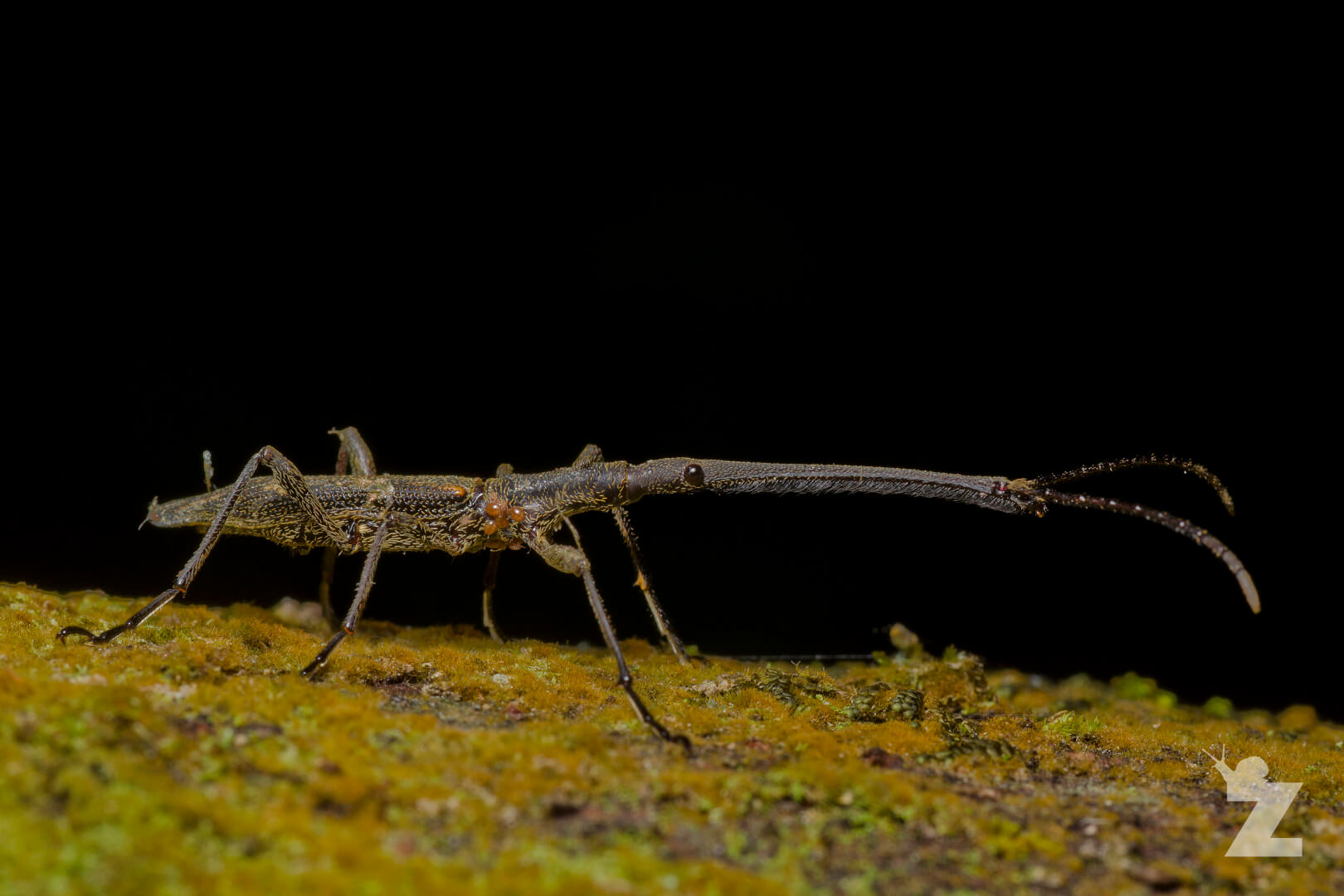
You will most likely encounter giraffe weevils in Spring and Summer. You’ll find them in native forest on trunks and logs in the North Island and northern South Island. During the summer months, the adults gather together on these tree trunks and branches where the females will drill holes in the tree surface to prepare a place to lay her eggs. The females have their antennae further back near their eyes, so that their mouth is free to bore into the bark.
Click to zoom in
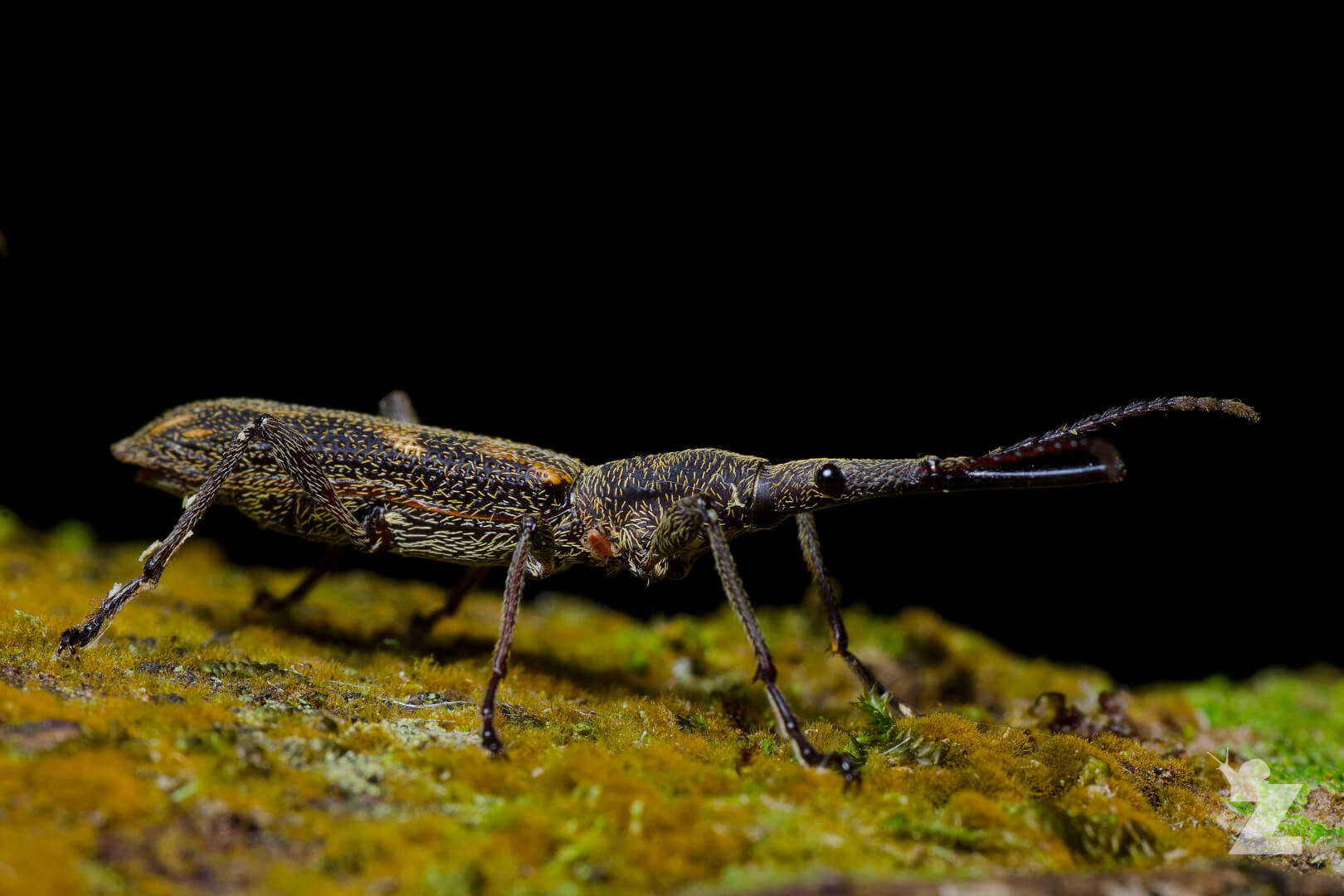
The larger males have their antennae at the tip of their rostrum. They use these elongated ‘snouts’ and enlarged mandibles to fight with other males for access to females for copulation. They will push, bite, pull and grapple other males. As the rostrum is used in these contests for females, it is highly likely to be under direct sexual selection.
Click to zoom in
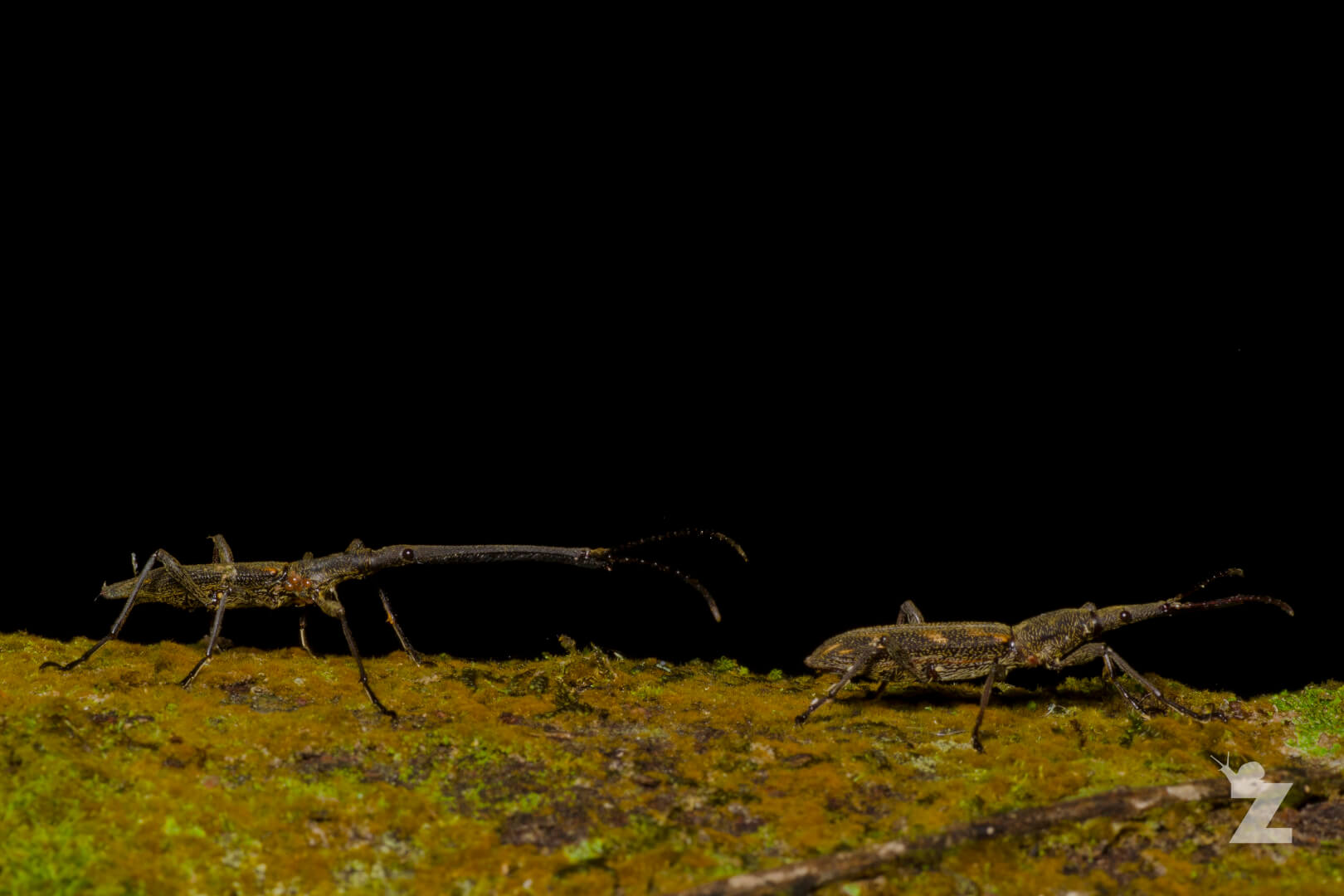
As for the giraffe weevils pictured, we came across them at Bushy Park Sanctuary, Whanganui, earlier this month. We found two males and one female. The first male was on the predator-proof fence, just below the lip which prevents mammalian pests (and weevils!) from climbing over. The second male and the female were both found on a log in a pile of cut up trees. It’s amazing what you can find on an afternoon stroll! Thanks, Bushy Park, for maintaining such a lovely piece of native forest.
References and Further Reading
Crowe, A. (2005). Which New Zealand Insect? (2nd ed.). Auckland: Penguin Books.
Landcare Research – Giraffe Weevil http://www.landcareresearch.co.nz/resources/teaching/Insects-and-spiders/Pare/Pare-arthropods/giraffe-weevil (Retrieved 10 April, 2017)
Painting CJ, Holwell GI (2013) Exaggerated Trait Allometry, Compensation and Trade-Offs in the New Zealand Giraffe Weevil (Lasiorhynchus barbicornis). PLoS ONE 8(11): e82467. https://doi.org/10.1371/journal.pone.0082467
Wikipedia – New Zealand giraffe weevil https://en.wikipedia.org/wiki/New_Zealand_giraffe_weevil (Retrieved 9 April, 2017)
 ZOOMOLOGY BLOG
Just love reading your stories!
Is that lice?
LikeLiked by 1 person
Aw, thanks, Sara 🙂 We’re glad you enjoy reading them!
If you are talking about the small, shiny, brown ‘balls’ attached to the male in the last picture, they are mites. https://en.wikipedia.org/wiki/Mite Good eyes!
LikeLike
A-mazing!
LikeLiked by 1 person
@thewonder86, Agreed!!! Love these guys 🙂
LikeLike
What a fabulous beetle, and interesting sexual dimorphism. I notice they have a few phoretic mites on them as well.
LikeLiked by 1 person
Thanks, Ray. 🙂 Fascinating, aren’t they? They do have a few hitchhikers!
-Emma
LikeLike